Sunday, 11 October 2015

Walking Simulator Plan

The name of my walking simulator will be Rusting Metal.
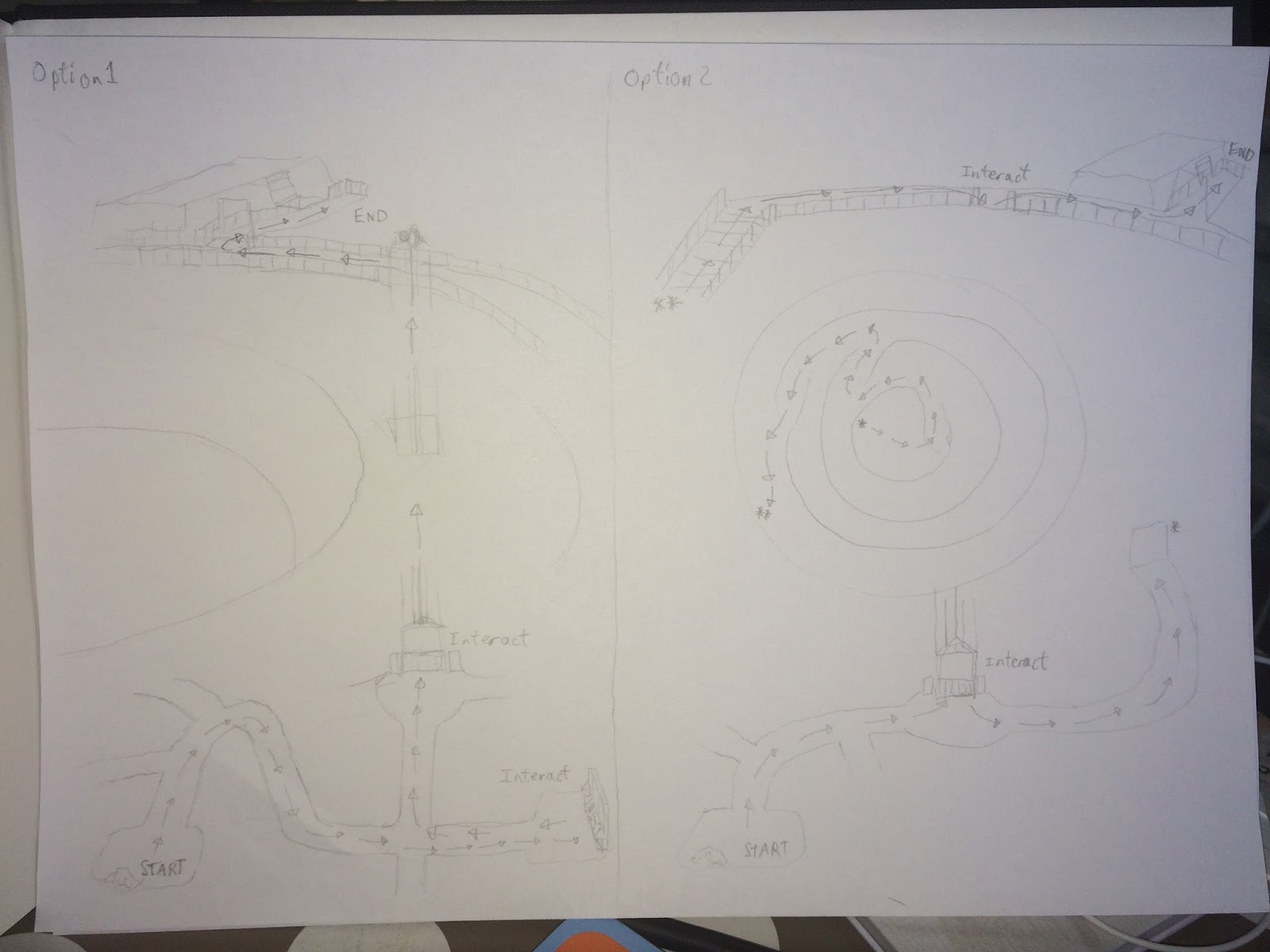
Here is the onesheet for the game. I will only be making the intro. The final result of this project will be a grey-box intro to the game.


I have created some maps and a storyboard for this project. I wanted to check whether or not I could have an elevator in the game so I created two options just in-case I couldn't.

Then I found out I could have an elevator in the project and made a better version of the map.


So now here is the storyboard.


That is it for the plan of my walking simulator. I am now beginning to model everything in Maya and put it together in Unity.

Life Drawing S03

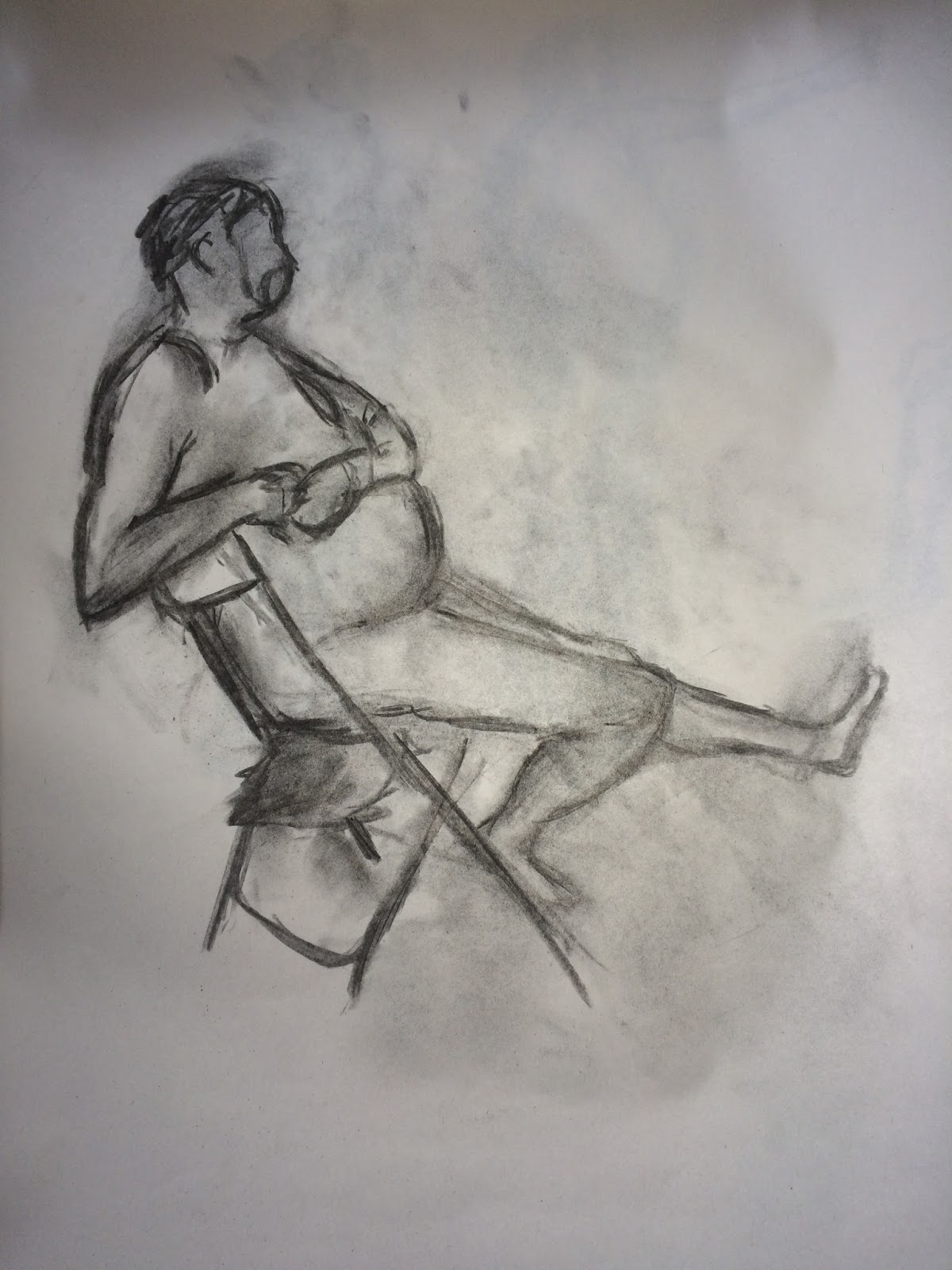
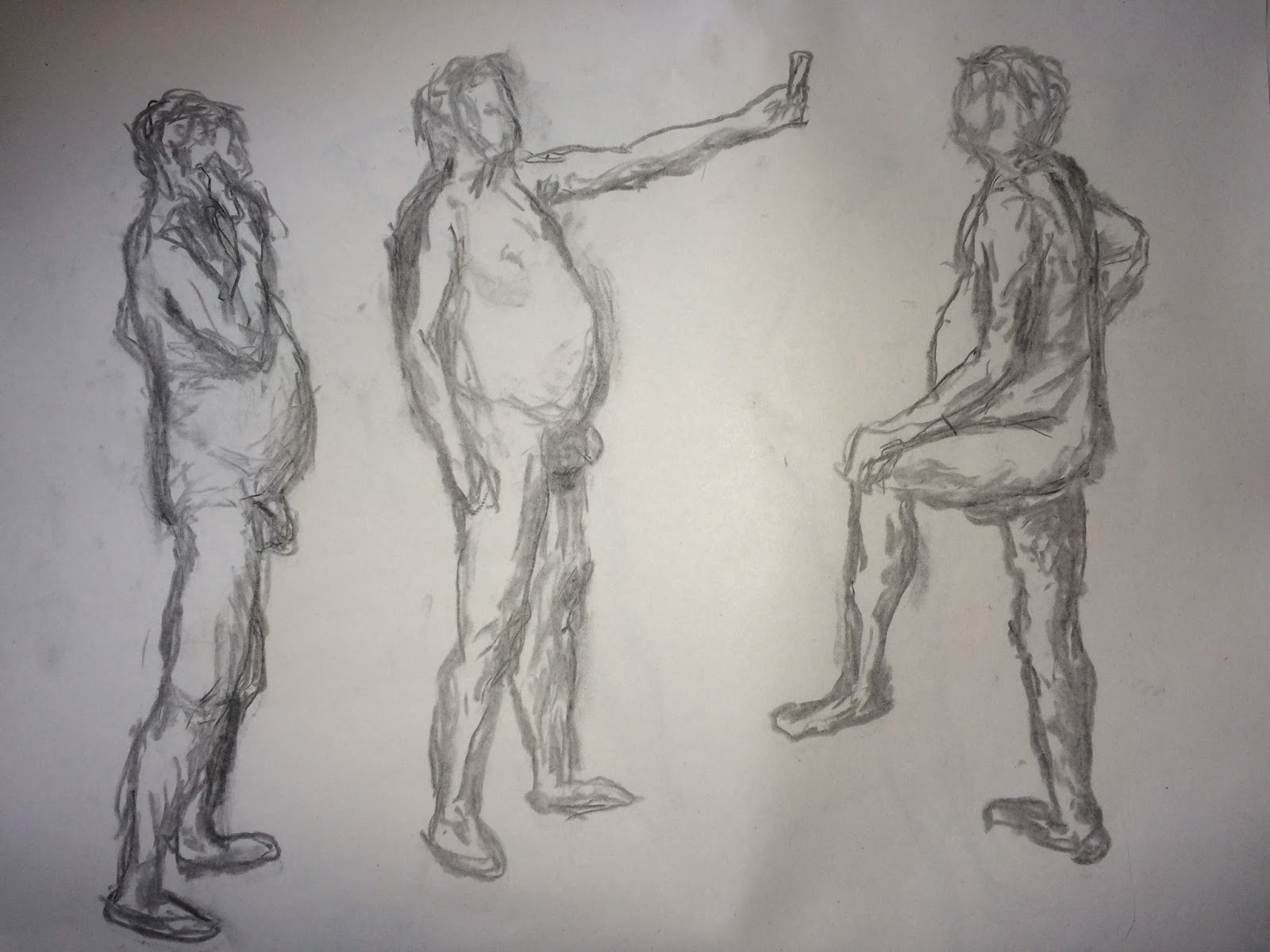
These drawings are my favourites from the 3rd Session of Life Drawing.

The first drawings aren't that different to what I have done before but I do like the form and proportions in them.


This style of sketching was to make us focus on value. As you can see, I went too dark with the first one. On the second, I improved on the value slightly.


These two drawings were done to music. The first one was done to gentle music and the second to rough music. I noticed a slight difference between the two when drawing. I drew the second one faster than the first. I think this corresponds to the music.


Finally, these sketches were drawn based on shape and form. I think I used too many lines in some of them. This is not my favourite style to draw, but I do like the style when it's done right. You might notice the large 'That is cool!' text. After we finished these we went round and had the opportunity to leave feedback on each other's work. Someone wanted to let me know that my left hand sketch using this method was 'cool!'. Also someone agreed.


Life Drawing S02

Here are some of my sketches from the second session of life drawing. I was happy with the proportions in these sketches. In this session we also tried out using our non-dominant hand which had some really interesting results.

The first drawing here was drawn as part of an interesting exercise where we all drew the model and then moved onto someone else's drawing and drew over it, correcting any mistakes. We did this quite a few times. Mine changed slightly, mostly the head and torso, but I am happy with how it turned out and found the process interesting.


I'm not too happy with the following sketches. This is because I didn't manage to get much shading and value and only had outlines. However, I am pleased with most of the proportions.


These 3 sketches were done with my left hand. When I stood back afterwards and looked at them I wondered why I hadn't used my left hand before! I was surprised they turned out so nicely.


Sunday, 4 October 2015

Battle Arena Greybox

The first term of the 3D Art Production Course entails creating a battle arena. As part of this project we must create a grey box version of our arena.

The idea of my arena is an abandoned mining operation. A corporation found an incredibly valuable resource buried on an asteroid underneath an ancient alien structure. However, after weeks of mining and the destruction of much of the sacred alien structure, one of the untouched structures came to life. It sent a beam of light up into the sky and part of it began floating. A day passed and nothing happened. Just as the corporation thought they were safe gigantic spiked rockets fell from the sky, aiming all over the facility. They struck at enormous speeds, ravaging the structures and vehicles. The remaining workers went into panic and tried to flee the facility. They did not escape. From the falling ships came hordes of alien monsters which tore the workers apart. Although the angered aliens destroyed the facility they made a fatal mistake. The facility was on a remote asteroid, so they had to keep fuel with them. They stored it in large tanks which were designed to withstand a lot. One of the smaller alien ships went straight into the central tank. It exploded and the expanding cloud of fire killed everything still living on the asteroid. The sight of the decrepit mine now is eerie.

For now we are just grey boxing our arena. Later on in the course we will make a statue to go in the arena. I have left a podium overlooking the mine to put a statue on. I think it will be of one of the aliens that the structure belonged too.
I'm really happy with how it turned out but I think maybe there should be more in the mine area.
Here are several images of my arena. Starting with the mood-board.


Crustaceans Concept Art

These are my designs for a brief of creating 3 creatures based on Crustaceans. We were told to watch a video by Feng Zhu who created character designs using the same silhouette method we had to. 
Here are some of the images I used for inspiration followed by the concepts I came up with.


My favourite of the three is the mutated hermit crab on the far right. It was a mistake that gave me the idea for it. I was drawing out the silhouette of a hermit crab and accidentally erased a line down the middle of the shell. This gave me the idea for a gaping mouth. I'm really pleased with the way it turned out.

The lobster monster happened when I thought of making a swimming creature rather than a walking one. I really like his colouring. I never intended for the orange but I was trying out different colours and it just went together with the blue in my opinion.

The last creature, the one on the left, turned out to be less crustacean than I wanted. His shape came from me playing around with a six legged creature. When I initially coloured him he was bright green and bright red. At the time, I thought it looked great. Then I realised that the colours just didn't suit a crustacean inspired creature. So I went for more ocean suited colours.

Here is a mood-board of some of the images I used for inspiration.

Friday, 2 October 2015

Islamic Art Research

Today we have been given a randomly selected subject to research. I am going to be researching Islamic Art.

Description

Islamic Art is the term used to define art produce in areas inhabited by an Islamic Population. I have not found a specific definition of this art and from what I have read it is very difficult to because of the large amount of art that has been produced in many Islamic areas over an enormous time period. It does not just encompass religious works. However, it does encompass any art that uses art traditions found in Muslim Culture. One of these traditions is the use of calligraphy in art.
Calligraphy is a prominent art form because of its meaning to Islam. It has a meaning of high status. It has a popular use in architecture as a decoration. 
Islamic Art is supposed to express more than just form and physicality. It is used to portray meaning and the nature of the art.


image

(Islamic Arts Magazine, 2014)


A brief history

Islamic Art is thought to have began around the beginning of the religion of Islam. Most of the earliest art created was ceramics and architecture. As time progressed, Islamic Art was influenced by different cultures and the art from them. The art found its way into textiles quite early on. Silks were a very popular style. It was around this early period that Calligraphy began to be used in art, mostly in pottery.
In the middle ages as Islam spread, textiles, woodwork, glasswork, metalwork and architecture are just some of the popular art forms that became incorporated into Islamic Art. Gold works, while less notable, also had there moments of popularity. Book painting also began to appear in this time. Many new techniques were discovered and used in Islamic Art throughout this period.
Since this time all of these areas of art have advanced and textiles have also gained popularity, such as carpets.


(Tanya Singh, 2015)


My take on the art

From what I have seen so far Islamic Art is all about symmetry and repeating patterns. I noticed that a lot of Islamic Art incorporates nature, usually flowers, and calligraphy. Mosaics, textiles and architecture seem to be the most popular styles of Islamic art. There isn't much of a range of colour in the art. A quick Google of Islamic Art returns images that mostly consist of blues, yellows and greens. The majority contain yellow as a major colour. I can't say that I like it but when the art is put into partnership with the environment and architecture of Islamic areas it's hard to say it doesn't work. While I might not like the common appearance of this art, I do like some of the modern takes on this art. They have more colour variety and it is more varied in style, there is less symmetry but the basic rules and ideals of the art are still present. There is  a large amount of calligraphy used in the modern pieces.
The style of Islamic art is very distinctive and means that you can instantly recognize Islamic Art. I think this is quite a unique aspect. There aren't many types of art that can you identify from a glance. 


dam-images-daily-2012-04-geometric-patterns-islamic-art-mitch-geometric-pattern-islamic-art-05.jpg
(Mitchell Owens, Photo:Gordon Mills/Alamy, 2012)


References

Islamic Arts Magazine.Šurković, K. (2014, April 10). 'Testimonial Verses', Islamic Calligraphy Masterpieces.
Retrieved from:
http://islamicartsmagazine.com/magazine/view/testimonial_verses_islamic_calligraphy_masterpieces/
Artist At Work Productions.
Singh, T. (2015, February 21). Iconoclastic Islamic Art.
Retrived from:
https://aawproductions.wordpress.com/2015/02/21/iconoclastic-islamic-art/
Architectural Digest.Owens, M. (2012, March 31). The Aesthete: Exploring Geometric Patterns in Islamic Art.Retrieved from:
http://www.architecturaldigest.com/story/geometric-patterns-islamic-art

Monday, 28 September 2015

Life Drawing S01

Here are the drawings that I created during my first life drawing session. We used a couple of techniques during this session such as continuous line and also measuring proportions to be more accurate.